Quick answer
Our overall pick for the best heart rate monitor for cycling is the Polar H10 chest strap, which its listing says connects over Bluetooth, ANT+ and 5 kHz. Armbands suit riders who want no strap across the chest, while the other chest straps in this list suit riders who want specific battery, app or sync features.
Looking for the best heart rate monitor for cycling? A heart rate monitor sends your heart rate to a bike computer, watch or phone app, and most models for riders come as either a chest strap or an armband. This guide covers 22 models, grouped by how they are worn and by what their listings emphasize. For more background, browse our Cycling Training articles.
Everything here comes from Amazon listings and manufacturer specifications, not from hands-on use. Where a listing does not state a specific detail, we say so instead of guessing.
Quick picks
- Overall pick: Polar H10 chest strap (see on Amazon)
- Armband with one button: Polar Verity Sense armband (see on Amazon)
- Strava and TrainingPeaks sync: XOSS X2 chest strap (see on Amazon)
- Road, MTB and gravel rides: CATEYE OHR-31 armband (see on Amazon)
- Three devices at once: COROS heart rate armband (see on Amazon)
22 Best Heart Rate Monitors for Cycling compared
| # | Product | Best for | Connectivity | Battery | Water resistance |
|---|---|---|---|---|---|
| 1 | Polar H10 chest strap | Best overall | Bluetooth, ANT+, 5 kHz | Not listed | Waterproof (rating not listed) |
| 2 | Garmin HRM 600 chest strap | Best for running dynamics on Garmin | Garmin devices and apps | Not listed | Not listed |
| 3 | XOSS X2 chest strap | Best for Strava and TrainingPeaks sync | ANT+ and Bluetooth | Up to 300 hours | IP67 |
| 4 | COOSPO H6 chest strap | Best for third-party app variety | Bluetooth 4.0, ANT+ | Not listed | IP67 |
| 5 | Herz P1 chest strap | Best for HRV, calories and steps | Bluetooth 5.0, ANT+ | Rechargeable (duration not listed) | IP67 |
| 6 | Magene H613 chest strap | Best for recording without a phone | Bluetooth and ANT+ | 100 hours, magnetic charging | IPX7 |
| 7 | Polar H9 chest strap | Best for a simple Polar chest strap | Bluetooth, ANT+ | Not listed | Waterproof (rating not listed) |
| 8 | Garmin HRM 200 chest strap | Best for a user-replaceable battery | Garmin devices and apps | Up to 1 year, user-replaceable | 3 ATM |
| 9 | COOSPO H9Z chest strap | Best for a built-in rechargeable battery | Bluetooth 5.0, ANT+ | Built-in rechargeable (duration not listed) | Not listed |
| 10 | ROCKBROS HRM812 chest strap | Best for auto wake and sleep | Bluetooth and ANT+ | CR2032, 800 hours | IP67 |
| 11 | Garmin HRM-Dual chest strap | Best for a 3.5-year battery | Not listed | Up to 3.5 years | Not listed |
| 12 | POWR LABS chest strap | Best for a fabric strap with wide adjustment | Bluetooth 4.0, ANT+ | 400+ hours, replaceable battery included | IPX67 |
| 13 | FITCENT chest strap | Best for a wireless charging dock | Bluetooth 5.0, ANT+, 5.3 kHz | Rechargeable with wireless dock | IP68 |
| 14 | Mo-Fit Trio chest strap | Best for a light 5.3 kHz strap | Bluetooth 5.0/4.0, ANT+, 5.3 kHz | Not listed | IP67 |
| 15 | Wahoo TICKR FIT armband | Best armband for the Wahoo Fitness app | Bluetooth and ANT+ | 30 hours, rechargeable | IPX7 |
| 16 | Polar Verity Sense armband | Best one-button armband | ANT+, dual Bluetooth | Not listed | Not listed |
| 17 | CATEYE OHR-31 armband | Best for road, MTB and gravel cycling | Bluetooth 5.0, ANT+ | Up to 24 hours, USB rechargeable | IPX7 |
| 18 | Scosche Rhythm+ 2.0 armband | Best for HRV and recovery insights | Bluetooth and ANT+ | Up to 24 hours | IP68 |
| 19 | COOSPO HW807 armband | Best armband with zone LED lights | Bluetooth 5.0, ANT+ | Not listed | Not listed |
| 20 | EZON heart rate armband | Best for five-color zone guidance | ANT+, Bluetooth 5.1 | Rechargeable (duration not listed) | Not listed |
| 21 | moofit HW401 armband | Best for flashing LED feedback | Bluetooth and ANT+ | Rechargeable (duration not listed) | IP67 |
| 22 | COROS heart rate armband | Best for three simultaneous devices | Bluetooth, up to three devices | 38 hours | Not listed |
How we chose
We compared manufacturer listings and specifications on Amazon as of November 2026. We did not use these products hands-on, so every feature, spec and claim below comes from the listing itself. Where a figure looked implausible or did not match the listing title, we left it out.
The criteria were how the monitor is worn, which connection types the listing names (Bluetooth, ANT+ or 5 kHz), what the listing says about battery type and life, the listed water rating, and any listed features such as offline storage, LED zone lights, HRV data or app compatibility. Where a listing gave no detail on one of these, we marked it as not listed.
Chest straps for training data and sync
These chest straps list features around data, app syncing, HRV or the way they connect to devices.
1. Best overall: Polar H10 chest strap

Pros
- Bluetooth, ANT+ and 5 kHz connectivity
- Listing says Bluetooth and ANT+ can run simultaneously
Cons
- The listing does not mention a battery life figure.
The Polar H10 is a black chest strap sized M-XXL and described in its title as waterproof. The listing says it connects over Bluetooth, ANT+ and 5 kHz, and that Bluetooth and ANT+ can run at the same time, along with two Bluetooth connections. Polar describes its improved electrodes, silicone dots and easy-to-use buckle as making the strap comfortable and interference-free.
Best for: Riders who want a chest strap that works with many devices and apps at once.
2. Best for running dynamics on Garmin: Garmin HRM 600 chest strap

Pros
- Machine-washable strap
- Sends heart rate and HRV to Garmin devices
Cons
- Many listed features are running-focused and add little for cycling-only riders.
The Garmin HRM 600 is a black chest strap in size M-XL, with a machine-washable strap available in two sizes. The listing says it sends real-time heart rate and HRV data to compatible Garmin smartwatches, cycling computers and apps. It also lists running dynamics such as stride length, vertical oscillation and ground contact time, and says it can record team-sport workouts to the Garmin Connect app.
Best for: Garmin owners who want heart rate and HRV data alongside running metrics.
3. Best for Strava and TrainingPeaks sync: XOSS X2 chest strap

Pros
- Listed battery life of up to 300 hours
- Adjustable strap listed for men, women and kids
Cons
- The listing does not say whether the battery is replaceable or rechargeable.
The XOSS X2 is a black chest strap with a listed heart rate range of 30 to 240 BPM. Its adjustable strap is listed at 25.59 to 37.4 inches and is described as suitable for men, women and kids. The listing says it syncs with Strava and TrainingPeaks and is compatible with Garmin and COOSPO bike computers. Battery life is listed as up to 300 hours, and the strap is rated IP67.
Best for: Riders who log rides to Strava or TrainingPeaks and want a long listed battery life.
4. Best for third-party app variety: COOSPO H6 chest strap
Pros
- Lists support for many named apps
- Bluetooth 4.0 and ANT+
Cons
- The listing does not mention battery life or battery type.
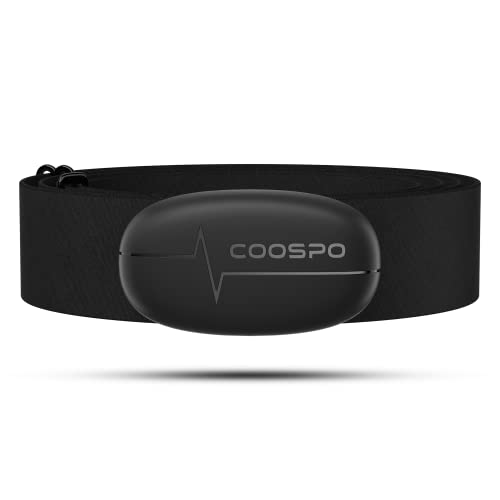
The COOSPO H6 is a black chest strap that the listing describes with ±1 BPM heart rate data and an IP67 rating. It supports Bluetooth 4.0 and ANT+ and names several apps, including Strava, Wahoo Fitness, Polar Beat, Zwift and Openrider. The listing says it works well with Garmin and COOSPO GPS bike computers, and its title names Peloton among compatible products.
Best for: Riders who use several training apps and want a dual-mode chest strap.
5. Best for HRV, calories and steps: Herz P1 chest strap

Pros
- 48-hour offline memory listed
- HRV, calories and steps reported
Cons
- The listing does not state a battery life figure.
The Herz P1 is a black chest strap that the listing describes as reading the heart’s electrical signal from the chest, with a range of 30 to 240 BPM. It broadcasts on Bluetooth 5.0 and ANT+ at once, with listed ranges of over 60 meters for Bluetooth and 30 meters for ANT+. It reports HRV, calories and steps and stores up to 48 hours offline. The adjustable belt is listed at 65 to 95 cm, and the unit is rated IP67.
Best for: Riders who want heart rate variability, calories and step count from one strap.
6. Best for recording without a phone: Magene H613 chest strap

Pros
- Up to 17 hours of offline storage
- Magnetic charging and battery display listed
Cons
- The listing gives only one size, Medium at 30 to 40 inches.
The Magene H613 is a chest strap that the listing says can store up to 17 hours of heart rate data without a phone, then sync to the OnelapFit app. The listing describes a 100-hour battery with magnetic charging and a visible battery level display. It supports Bluetooth and ANT+ and is rated IPX7. The title also describes a multi-color heart rate zone indicator.
Best for: Riders who want heart rate stored on the strap and synced to an app later.
Chest straps for low-maintenance daily use
These chest straps focus on battery life, battery type, washing or fit.
7. Best for a simple Polar chest strap: Polar H9 chest strap
Pros
- Two listed size ranges
- Works with ANT+ and Bluetooth
Cons
- The listing does not mention battery type or battery life.
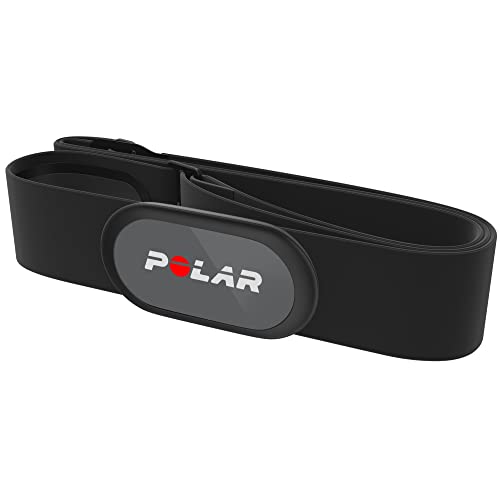
The Polar H9 is a black chest strap with a soft strap and two listed size ranges: XS-S for 20 to 26 inches and M-XXL for 26 to 36 inches. The listing says it is waterproof and works with ANT+ and Bluetooth equipment. Polar presents it as a dependable everyday choice and says its high accuracy sensors are the basis of its tracking.
Best for: Riders who want a waterproof Polar chest strap with a soft strap and listed sizing.
8. Best for a user-replaceable battery: Garmin HRM 200 chest strap

Pros
- User-replaceable battery, up to 1 year listed
- 3 ATM water rating listed
Cons
- The listing does not name Bluetooth or ANT+ directly.
The Garmin HRM 200 is a black chest strap in size M-XL, with an XS-S to M-XL strap range. The listing says it transmits real-time heart rate and heart rate variability data to compatible Garmin smartwatches, cycling computers, fitness equipment and apps. It lists up to 1 year of battery life with a user-replaceable battery, a 3 ATM water rating and a machine-washable strap.
Best for: Riders who want a Garmin strap with a battery they can replace themselves.
9. Best for a built-in rechargeable battery: COOSPO H9Z chest strap

Pros
- Built-in rechargeable battery
- Bluetooth 5.0 and ANT+
Cons
- The listing does not state how long one charge lasts.
The COOSPO H9Z is a black chest strap with a built-in rechargeable battery, which the listing says removes the need for disposable batteries. The strap is described as adjustable and made from soft, breathable materials. The listing says it syncs with fitness apps and devices over Bluetooth 5.0 or ANT+, including cycling computers. The listing describes it as lightweight and barely noticeable.
Best for: Riders who prefer to recharge a strap rather than replace batteries.
10. Best for auto wake and sleep: ROCKBROS HRM812 chest strap

Pros
- Auto wake and sleep when worn or removed
- 800-hour battery life listed
Cons
- Uses a CR2032 button battery, per the listing.
- The listing does not describe how to replace the battery.
The ROCKBROS HRM812 is a black chest strap with a detachable main unit. The listing says it wakes when correctly worn and sleeps when detached, and it lists a range of 30 to 240 BPM. It uses a CR2032 button battery with a listed battery life of 800 hours. The sensor is rated IP67 for water and sweat resistance, and the listing gives weights of about 13 grams for the main unit and about 32 grams for the strap.
Best for: Riders who want a strap that switches on when worn and off when removed.
11. Best for a 3.5-year battery: Garmin HRM-Dual chest strap

Pros
- Heart rate module can be removed for washing
- Battery listed for up to 3.5 years
Cons
- The listing does not mention Bluetooth, ANT+ or a water rating.
The Garmin HRM-Dual is a black chest strap with a soft, adjustable strap. The listing says you can remove the heart rate module and wash it, and that the battery lasts up to 3.5 years. The listing does not describe a connection type or a water rating, so check the full product page for those details before buying.
Best for: Riders who want a removable, washable heart rate module with a long listed battery life.
12. Best for a fabric strap with wide adjustment: POWR LABS chest strap
Pros
- 400+ hour battery life listed
- Replaceable battery included
Cons
- The listing gives two chest ranges, 24 to 61 inches in the features and 26 to 38 inches in the title, so check the fit.
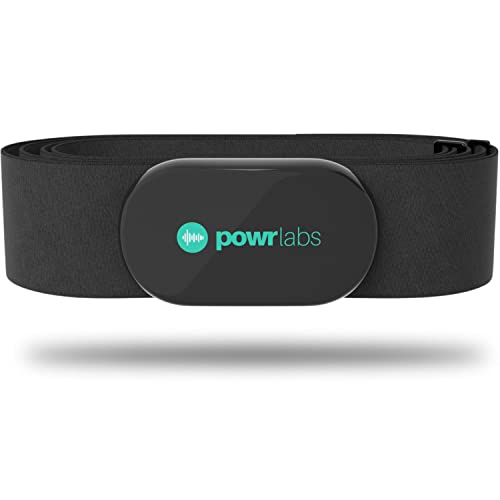
The POWR LABS chest strap is black and uses dual-band Bluetooth 4.0 and ANT+ connectivity. The listing describes a soft fabric strap that adjusts from 24 to 61 inches. It lists a battery life of 400 or more hours and says a replaceable battery is included. The listing rates it IPX67 for water and sweat resistance.
Best for: Riders who want a fabric chest strap with a long listed battery life and a wide adjustment range.
13. Best for a wireless charging dock: FITCENT chest strap
Pros
- Included wireless charging dock
- IP68 rating and 5.3 kHz support
Cons
- The listing does not state how long one charge lasts.
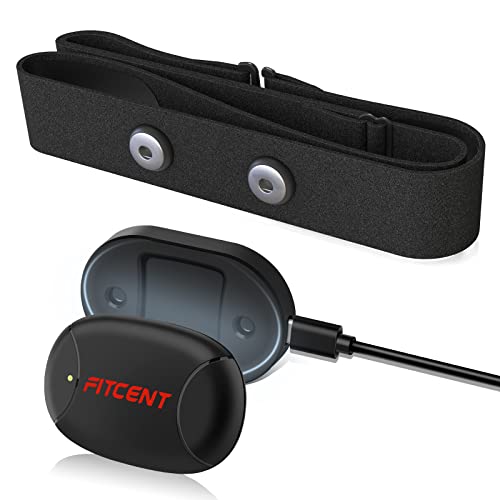
The FITCENT chest strap is black and, according to the listing, reads the heart’s electrical signal directly rather than using optical sensors. It supports Bluetooth 5.0, ANT+ and 5.3 kHz connections. The listing says it has a rechargeable battery and an included wireless dock. It is rated IP68 and described as submersible to 10 meters. The adjustable strap is described as skin-friendly.
Best for: Riders who prefer a rechargeable strap that charges on an included wireless dock.
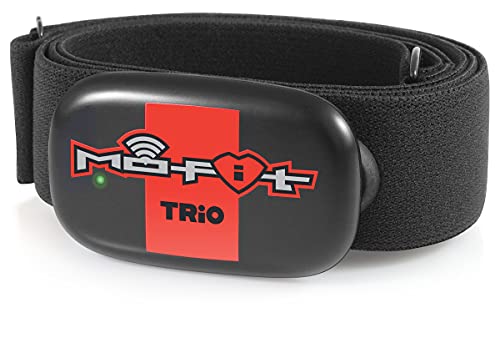
14. Best for a light 5.3 kHz strap: Mo-Fit Trio chest strap
Pros
- Listed weight of 1.8 ounces
- Supports 5.3 kHz equipment
Cons
- The listing does not mention battery life or battery type.
The Mo-Fit Trio is a black chest strap in one size, adjustable from 26 to 39 inches. The listing gives its weight as 1.8 ounces and describes a finely woven elastic strap. It connects over Bluetooth 5.0 and 4.0, ANT+ and 5.3 kHz, and the listing names Garmin, Peloton and other devices as compatible. The housing is described as IP67 water resistant.
Best for: Riders who want a light chest strap that also supports 5.3 kHz gym equipment.
Armbands for cycling and workouts
These optical armbands skip the chest strap and list features such as LED lights, connection status and water ratings.
15. Best armband for the Wahoo Fitness app: Wahoo TICKR FIT armband

Pros
- Optical armband, no chest strap
- One LED shows connection status
Cons
- The listing does not mention a display on the sensor.
The Wahoo TICKR FIT is an optical armband with no chest strap, offered in small and large strap sizes. The listing says it connects over Bluetooth and ANT+ to smartphones and GPS devices, and it lists a 30-hour rechargeable battery and an IPX7 rating. One LED light shows connection status while the device searches, connects and reads heart rate. The listing also says it tracks calories and workout time in the Wahoo Fitness app.
Best for: Riders who train with the Wahoo Fitness app and want an armband with a listed battery.
16. Best one-button armband: Polar Verity Sense armband

Pros
- One-button operation
- Two simultaneous Bluetooth channels listed
Cons
- The listing does not mention a battery life figure or a water rating.
The Polar Verity Sense is a black optical armband sized S-L. The listing says you can wear it on the upper or lower arm, clip it to goggles, or place it under tight-fitting clothing, and that it has only one button. It lists live heart rate broadcasting, two simultaneous Bluetooth channels and limitless ANT+ connections. You can also record a session and transfer the data to your phone afterward.
Best for: Riders who want a small optical armband with a single button and several connection options.
17. Best for road, MTB and gravel cycling: CATEYE OHR-31 armband

Pros
- USB rechargeable, up to 24 hours listed
- Works with Cateye Cycling per the listing
Cons
- Only one size is listed, so fit options are not described.
The CATEYE OHR-31 is a compact black optical armband offered in one size. The listing says it connects over Bluetooth 5.0 and ANT+ to cycling computers and smartphone apps, including Cateye Cycling. It is USB rechargeable with up to 24 hours of run-time and is rated IPX7. The title names road, MTB and gravel cycling as its intended uses.
Best for: Cyclists who ride road, mountain or gravel routes and want a USB rechargeable armband.
18. Best for HRV and recovery insights: Scosche Rhythm+ 2.0 armband

Pros
- HRV and RR interval data listed
- IP68 waterproof rating
Cons
- The listing does not mention how the device is charged.
The Scosche Rhythm+ 2.0 is an optical armband with a lightweight, breathable strap that adjusts to the forearm, bicep or tricep. Its HRV mode captures RR interval data, which the listing says can be streamed to a compatible app for training and recovery insight. The listing gives up to 24 hours of battery life and an IP68 waterproof rating. It connects over Bluetooth or ANT+.
Best for: Riders who want heart rate variability and RR interval data from an armband.
19. Best armband with zone LED lights: COOSPO HW807 armband

Pros
- Color LED zone lights listed
- Listing names more than 200 compatible apps
Cons
- The listing does not mention battery life or a water rating.
The COOSPO HW807 is a grey optical armband that the listing says uses patented optical sensor technology and is accurate to ±1 BPM. Different color LED lights show heart rate zones, and the device supports HRV. It connects over Bluetooth 5.0 and ANT+ to smartphones, Garmin and Wahoo watches, bike computers and fitness equipment. The listing names more than 200 apps.
Best for: Riders who want heart rate zones shown by LED lights and HRV support in an armband.
20. Best for five-color zone guidance: EZON heart rate armband

Pros
- Five LED zone colors
- Up to three devices at once
Cons
- The listing does not state a battery life figure.
- The listing does not mention a water rating.
The EZON armband is black and lists a strap size of 8 to 14 inches. The listing describes 4-channel optical tracking and five LED colors that flash for zones labeled Warm-up, Fat Burn, Cardio, High-Intensity and Peak. It is listed as rechargeable and supports Bluetooth 5.1 and ANT+, with up to three devices at once. The strap is described as ultra-light and soft.
Best for: Riders who want zone colors on the armband itself and a light strap for arms of 8 to 14 inches.
21. Best for flashing LED feedback: moofit HW401 armband

Pros
- Flashing LED shows heart rate and connection
- IP67 rating
Cons
- The listing does not state a battery life figure.
The moofit HW401 is a black optical armband rated IP67 for sweat and water resistance. The listing says a flashing LED confirms heart rate and connection, with blue lights shown during search and connection. It supports Bluetooth and ANT+ dual mode and is rechargeable. The title names Wahoo and Strava among the apps it works with.
Best for: Riders who want a flashing LED to confirm heart rate and connection status.
22. Best for three simultaneous devices: COROS heart rate armband

Pros
- Pairs with up to three devices at once
- Auto-wear detection and 38-hour battery listed
Cons
- The listing says it is not intended to collect heart rate data for daily tracking.
- It includes a USB cable but no Type-C adapter, per the listing.
The COROS Heart Rate Monitor is a grey armband with auto-wear detection, listed in a Standard size, with a large band for arms of 9.4 to 16.9 inches. The listing says the fabric band is soft and breathable and that the sensor can be removed for cleaning. It lists 38 hours of battery life and says it can pair with up to three devices at once.
Best for: Riders who want one armband paired with several devices at the same time.
How to choose the best heart rate monitor for cycling
Start with how you want to wear it. Chest straps sit around the chest under a jersey, while armbands sit on the forearm, upper arm or bicep. Neither style is listed as better for every rider, so compare the wear options in each listing and choose the one that fits your riding clothes and comfort.
Next, check the connection types. Most listings in this roundup name Bluetooth, ANT+ or both, and some add 5 kHz for certain gym equipment. Bluetooth is what most phones use, and ANT+ is common on bike computers and watches. Match the protocols to the devices you already own, and confirm them in the listing before you buy.
Then look at the power source. Some listings name a rechargeable battery, others a replaceable coin cell, and some give a battery life without saying how the battery is changed. Follow the manufacturer’s manual for charging, replacing and handling batteries.
Water and sweat ratings matter on wet rides. Codes such as IPX7, IP67 and IP68 appear in the listings, so use the rating printed on the product page rather than assuming one. For heat, electrical and safety questions, follow the manufacturer’s manual.
Finally, consider extras such as offline storage, LED zone lights and HRV data. They can be useful, but none is required for a basic ride. For a structured start, see our beginner cycling training plan.
What to look for
- Wear style: chest strap or armband, and how comfortable it is for your riding clothes.
- Connectivity: Bluetooth, ANT+ or 5 kHz, matched to your bike computer, watch or app.
- Battery: rechargeable or replaceable, with the listed battery life.
- Water rating: the IP or IPX code printed in the listing.
- Extras: offline storage, LED zone lights, HRV data or multi-device pairing, only if you will use them.
FAQ
Do I need a chest strap for cycling?
Not always. Both chest straps and armbands appear in this roundup for cycling. Listings describe chest straps as worn across the chest and armbands as worn on the arm, so choose based on comfort and the devices you use.
Bluetooth or ANT+: which should I choose?
Choose the protocol your bike computer, watch or app supports. Many listings here name both, so one sensor can often work with several devices. Check your device’s manual for pairing steps.
Do I need a rechargeable model?
Not necessarily. Some listings name a rechargeable battery, some a replaceable one, and some give no battery details. Compare the listed battery type and life, and follow the manufacturer’s manual for charging and replacement.
How should I set heart rate goals?
For general activity goals, the U.S. Department of Health and Human Services summarizes public guidance on physical activity guidelines. Our listings do not give target numbers, so talk with a clinician about any health questions. You can also explore more of our Cycling Training guides.
References
- Amazon product listings and manufacturer specifications (accessed November 2026)
- U.S. Department of Health and Human Services, Physical Activity Guidelines