Quick answer
Our overall pick is the Sportneer Magnetic Indoor Trainer Stand, which lists six resistance levels on a bar-mounted remote, a wide wheel fit and a front wheel riser block. The Yaheetech suits riders who want the lightest listed weight, and the folding models suit people with limited storage space.
If you are looking for the best indoor bike trainer for beginners, the right choice usually depends on your wheel size, the type of resistance you want and how much room you have. This roundup compares 11 trainers using Amazon listing data and manufacturer specifications, not hands-on testing.
Quick picks
- Overall pick for six levels and a wide wheel fit: Sportneer Magnetic Indoor Trainer Stand (see on Amazon)
- Fluid resistance for 26-29 inch wheels: Sportneer Fluid Indoor Bike Trainer (see on Amazon)
- Lightest listed weight: Yaheetech Magnetic Steel Bike Trainer (see on Amazon)
- Folds for storage in a car trunk: VEVOR Foldable Magnetic Bike Trainer (see on Amazon)
11 Best Indoor Bike Trainers for Beginners compared
| # | Product | Best for | Weight | Resistance | Wheel fit |
|---|---|---|---|---|---|
| 1 | Sportneer Magnetic Indoor Trainer Stand | Best overall: remote control and riser block | 19.3 lb | 6 levels, magnetic | 26-28 in and 700C |
| 2 | Alpcour Magnetic Bike Trainer with Bag | Best for carrying with its listed bag | 20.6 lb | 6 fixed levels, magnetic | Not listed |
| 3 | CXWXC Magnetic Bike Trainer | Best for a pyramid-style frame | 22.15 lb | 6 levels, magnetic | 26-29 in and 700C |
| 4 | D-GROEE Magnetic Bike Trainer Stand | Best for a 440-pound listed load rating | 18.8 lb | 6 levels, magnetic | 26-28 in and 700C |
| 5 | Alpcour Fluid Bike Trainer Stand | Best for progressive fluid resistance | Not listed | Progressive fluid | Not listed |
| 6 | Sportneer Fluid Indoor Bike Trainer | Best for 26-29 inch wheels | 24.25 lb | Fluid | 26-29 in and 700C |
| 7 | Goplus Folding Bike Trainer Stand | Best for eight resistance levels | Not listed | 8 levels, magnetic | 26-28 in |
| 8 | GYMAX Magnetic Bike Trainer Stand | Best for narrow-space storage | 17.5 lb | 8 levels, magnetic | Not listed |
| 9 | VEVOR Foldable Magnetic Bike Trainer | Best for folding into a car trunk | 17.31 lb | 6 levels, magnetic | 26-29 in and 700C |
| 10 | Yaheetech Magnetic Steel Bike Trainer | Best for the lightest listed weight | 13.8 lb | Magnetic, level count not listed | 26-28 in and 700C |
| 11 | FDW Magnetic Bike Trainer Stand | Best for a simple five-level setup | 17.6 lb | 5 levels, magnetic | Not listed |
How we chose
We compared manufacturer listings and specifications on Amazon as of November 2026. Every fact below comes from the listing data.
The criteria covered the wheel sizes each listing states, the type of resistance and number of levels, the listed weight, whether the trainer folds for storage, and what each listing says about noise and stability.
Best for magnetic resistance you control from the handlebars
These four trainers describe magnetic resistance adjusted from the handlebar area.
1. Best overall: remote control and riser block: Sportneer Magnetic Indoor Trainer Stand

Pros
- Six resistance levels on a bar-mounted remote
- Press-down lever clamp for quick mounting
- Front wheel riser block included
Cons
- The listing does not mention a folding design
- At 19.3 pounds it is heavier than several options here
This magnetic trainer fits 26-28 inch and 700C wheels and lists a rear axle range of 4.92 to 6.57 inches. A bar-mounted remote switches among six resistance levels. The listing describes a press-down lever clamp for quick mounting and includes a front wheel riser block. The listed weight is 19.3 pounds.
Best for: Riders who want remote-controlled magnetic levels and a wide wheel fit in one trainer.
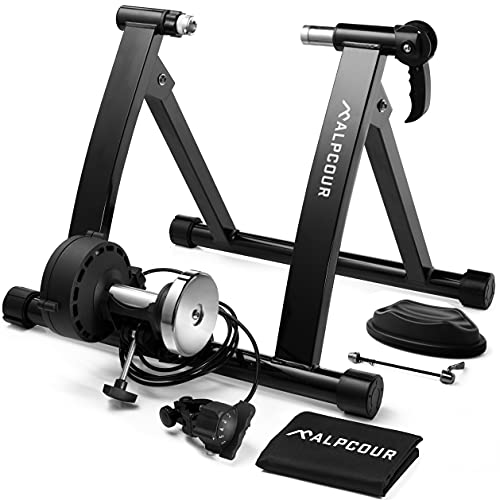
2. Best for carrying with its listed bag: Alpcour Magnetic Bike Trainer with Bag
Pros
- Six fixed levels with a handlebar cable controller
- Bag listed in the title
- Quick lever release and anti-slip pads
Cons
- The listing describes fixed levels rather than a range
- At 20.6 pounds it is heavier than several options here
This foldable magnetic trainer is listed with six fixed resistance levels, selected with a handlebar-mounted cable controller. The listing describes a flywheel mechanism with noise reduction, an extra wide base and anti-slip rubber pads. The title lists a bag and a quick lever release. The listed weight is 20.6 pounds.
Best for: Riders who plan to move the trainer often and want a carry bag listed with it.
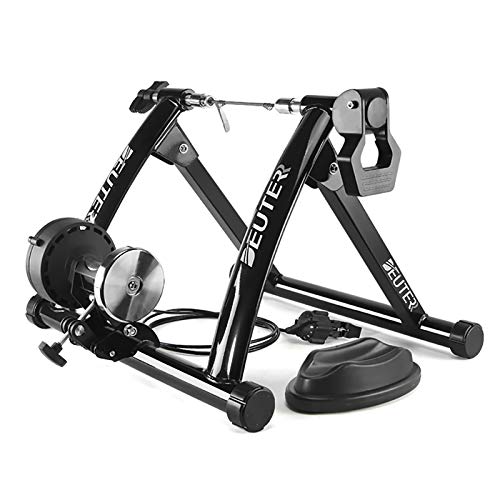
3. Best for a pyramid-style frame: CXWXC Magnetic Bike Trainer
Pros
- Six levels changed from the handlebars
- Pyramid structure described for stability
- Quick release skewer and riser block listed in the title
Cons
- The listing recommends smooth tires to reduce vibration
- At 22.15 pounds it is among the heavier options here
This magnetic trainer uses a drive-by-wire device so you change the six resistance levels from the handlebars. The listing describes a pyramid structure when unfolded for stability and a high load-bearing capacity. The title says it fits 26-29 inch and 700C wheels and includes a quick release skewer and front wheel riser block. The listed weight is 22.15 pounds.
Best for: Riders who want handlebar-controlled levels and a frame the listing describes as stable.
4. Best for a 440-pound listed load rating: D-GROEE Magnetic Bike Trainer Stand

Pros
- 440-pound load rating listed in the title
- Six levels from a handlebar-mounted remote
- Aluminum alloy roller described for smooth operation
Cons
- Listed dimensions differ between the feature text and the spec fields, so confirm before buying
- The listing does not mention a folding design
This magnetic trainer lists six resistance levels controlled from a handlebar-mounted remote, along with an aluminum alloy roller. The title lists a 440-pound load rating and fit for 26-28 inch and 700C bikes. It uses a press-down lever clamp and a front wheel riser block for mounting. The listed weight is 18.8 pounds.
Best for: Riders who want a remote-controlled magnetic trainer with a high listed load rating.
Best for fluid-resistance trainers
These two use a fluid resistance wheel, which both listings describe as quiet.
5. Best for progressive fluid resistance: Alpcour Fluid Bike Trainer Stand

Pros
- Progressive fluid resistance described in the listing
- Stainless steel frame with anti-slip rubber pads
- Dual tension knob and lock ring
Cons
- The listing does not state a weight
- The listing does not state which wheel sizes it fits
This fluid trainer uses an impeller inside the wheel’s liquid, which the listing says increases resistance as you pedal faster. The stand is built from stainless steel and includes a front wheel riser block, anti-slip rubber pads and a dual tension knob with lock ring. The title describes it as portable and foldable.
Best for: Riders who want resistance that the listing says rises with pedal speed.
6. Best for 26-29 inch wheels: Sportneer Fluid Indoor Bike Trainer

Pros
- Fits bikes listed at 26-29 inches and 700C
- Fluid wheel described as quiet
- Dual locking system and front wheel riser block
Cons
- At 24.25 pounds it is heavier than most options here
- The listing does not mention a folding design
This fluid trainer lists compatibility with bikes between 26 and 29 inches and with 700C bikes. The listing describes a fluid resistance wheel for whisper-quiet spinning and a heavy-duty stainless steel frame. A dual locking system and an extra wide frame with a front wheel riser block are described for stability. The listed weight is 24.25 pounds.
Best for: Riders with 26-29 inch or 700C wheels who want a fluid trainer with a wide frame.
Best for folding and tight storage
These three trainers describe folding designs for carrying or storing indoors.
7. Best for eight resistance levels: Goplus Folding Bike Trainer Stand

Pros
- Eight resistance levels
- Double locking system described in the listing
- Folding design that needs no other tools
Cons
- The listing does not state a weight
- The listing data does not mention a front wheel riser block
This folding trainer is listed with eight resistance levels and a magnetic flywheel for bikes with 26 to 28 inch wheels. The listing describes a double locking system that holds the bike firmly and a folding design that needs no other tools for setup. Listed dimensions are 21 inches high, 23.5 inches long and 15.5 inches wide.
Best for: Riders who want more resistance settings in a folding stand.
8. Best for narrow-space storage: GYMAX Magnetic Bike Trainer Stand

Pros
- Eight resistance levels
- Foldable design for narrow spaces
- Quick release lever and dual-lock system
Cons
- The listing data does not state wheel sizes
- The listing does not mention a front wheel riser block
This magnetic trainer is listed with eight resistance levels and a quick release lever. The listing describes a dual-lock system and a foldable design for compact indoor storage, especially in narrow spaces. It lists a net weight of 17.5 pounds, with dimensions of 15.5 inches high, 23.5 inches long and 21 inches wide.
Best for: Home riders with narrow rooms who need to fold the trainer away after each session.
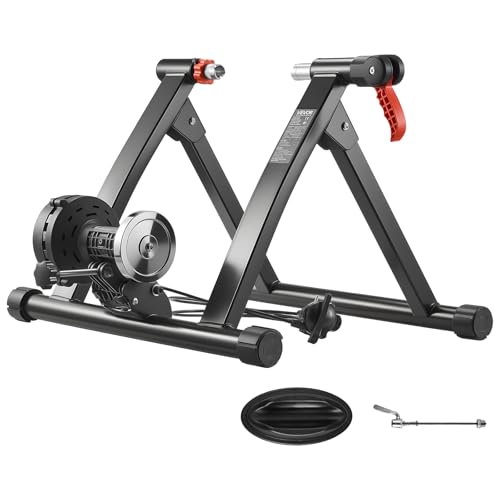
9. Best for folding into a car trunk: VEVOR Foldable Magnetic Bike Trainer
Pros
- Six magnetic resistance levels
- Quick-release lever for setup
- Front wheel riser block included
Cons
- The listing does not give a noise rating
- At 17.31 pounds it is heavier than the lightest option here
This foldable magnetic trainer lists six resistance levels and compatibility with 26-29 inch and 700C wheels. The listing describes a heavy-duty aluminum alloy shaft and a low-noise motor designed to reduce friction and vibration. It includes a quick-release lever and a front wheel riser block, and it is listed at 17.31 pounds. The listing says it can be carried in a car trunk.
Best for: Riders who want a folding trainer they can store or transport easily.
Best for lighter, simpler setups
These two list lighter frames or fewer resistance levels, which can suit a simpler routine.
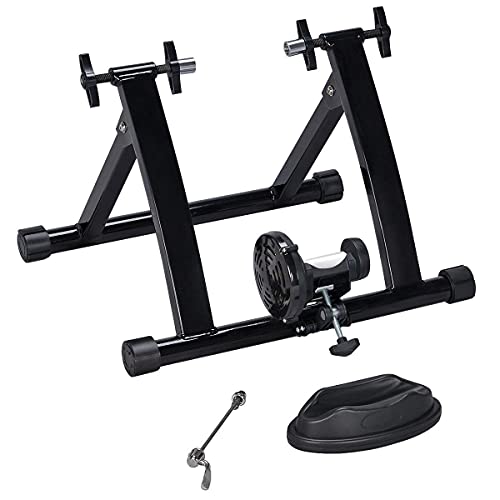
10. Best for the lightest listed weight: Yaheetech Magnetic Steel Bike Trainer
Pros
- Lightest listed weight at 13.8 pounds
- Four non-slip feet caps
- Quick release skewer included
Cons
- Thru-axle adapters are not included, so thru-axle bikes need them
- The listing does not state the number of resistance levels
This magnetic steel trainer fits 26-28 inch and 700C wheels and comes with a quick release skewer. The listing says it needs a bike with a rear quick-release wheel and that thru-axle adapters are not included. Four non-slip feet caps are described to help keep it in place. It is listed at 13.8 pounds, the lowest weight in this roundup.
Best for: Riders with quick-release bikes who want the lightest listed frame.
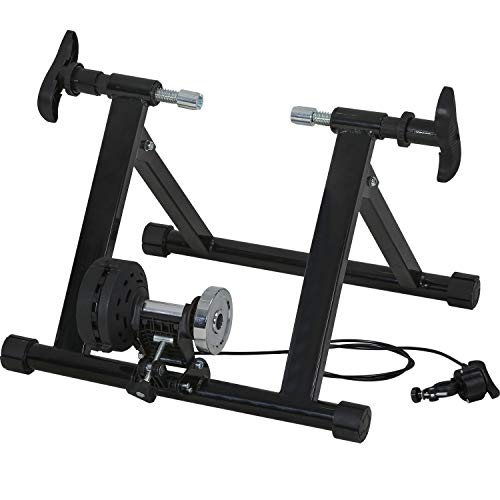
11. Best for a simple five-level setup: FDW Magnetic Bike Trainer Stand
Pros
- Five resistance levels
- Folds for carrying and storage
- Assembly described as about 15 minutes
Cons
- The listing data does not mention a quick-release lever
- Five levels offers fewer settings than the six or eight listed by others
This steel magnetic trainer is listed with five resistance levels. The listing describes assembly with a small number of spare parts, which it says can be finished in about 15 minutes by following the instructions. The trainer is designed to fold for carrying and storage. The listing describes a super mute feature at the first resistance level and lists a weight of 17.6 pounds.
Best for: Riders who want a straightforward set of five levels and a short assembly.
How to choose the best indoor bike trainer for beginners
Start with your bike. Most trainers in this roundup clamp onto the rear wheel, so the listed wheel sizes matter. Some listings say 26-28 inch and 700C, while others say 26-29 inch. Check your wheel size and axle type before you buy. The Yaheetech listing, for example, says it needs a bike with a rear quick-release wheel and that thru-axle adapters are sold separately.
Next, look at resistance. The magnetic trainers in this list describe adjustable levels, with five, six or eight levels stated in the listings. Fluid trainers describe resistance built by a liquid-filled wheel. Neither type is presented as better in every case, so choose the one whose listed features match how you plan to ride. For more on building a routine, browse our beginner training articles and the wider cycling training hub.
Think about space and storage. If you will move or store the trainer, folding designs are easier to tuck away, and several listings describe folding frames. Weight also matters. A lighter trainer is easier to carry, while a heavier frame is harder to move around the house.
Noise and floor care deserve attention too. Listings describe quiet operation, but they also note that sound can come from contact between the tire and the roller. Some listings recommend smooth tires, and one suggests adding carpet to reduce indoor resonance.
Plan your sessions so the trainer actually gets used. Our first month of cycling guide explains what early weeks can look like, and our eight-week beginner cycling training plan offers a structure. For general activity guidance, see the federal physical activity guidelines. After sessions, our post-ride recovery article covers what to do next.
Safety comes first. Assemble, adjust and use any trainer exactly as the manufacturer’s manual describes, and confirm that your bike is secure before you start pedaling.
What to look for
- Wheel size and axle type listed for your bike
- Resistance type and the number of levels stated
- Listed weight and whether the trainer folds
- Noise and stability notes, and any tire recommendations
FAQ
Do I need a quick-release rear wheel?
Some listings, including the Yaheetech, say the trainer is designed for bikes with quick-release axles and that thru-axle adapters are needed for thru-axle bikes. Check your bike’s axle type and follow the manufacturer’s manual before buying.
Is magnetic or fluid resistance better for beginners?
Neither is described as better in every case. Magnetic trainers in this list describe adjustable levels, while fluid trainers describe a liquid-filled wheel. Compare the listed features against how you plan to ride.
How do I start riding on a trainer?
Start with short, easy sessions and build gradually. Our eight-week beginner training plan and guide to weekly riding frequency can help you plan.
References
- Amazon product listings and manufacturer specifications (accessed November 2026)
- U.S. federal physical activity guidelines, odphp.health.gov